


Types of Astrology: Which Is Perfectfor You?
Astrology has remained one of humanity’s oldest traditions for understanding life, destiny, and cosmic influences. Over thousands of years, different cultures developed unique approaches for observing celestial patterns and interpreting their impact on human behaviour and events. When someone begins exploring various types of astrology, they quickly realize that this field is far more diverse than it appears on the surface. From classical Vedic wisdom to Western zodiac traditions, each astrology system carries its own philosophy, method, and purpose.
In this blog, we will walk through the various types of astrology followed across the world, including the different types of Vedic astrology, along with international systems such as Chinese, Celtic, and Egyptian astrology. This guide offers a balanced blend of structured points and explanatory paragraphs so that reading becomes effortless and informative.
1. Western Astrology
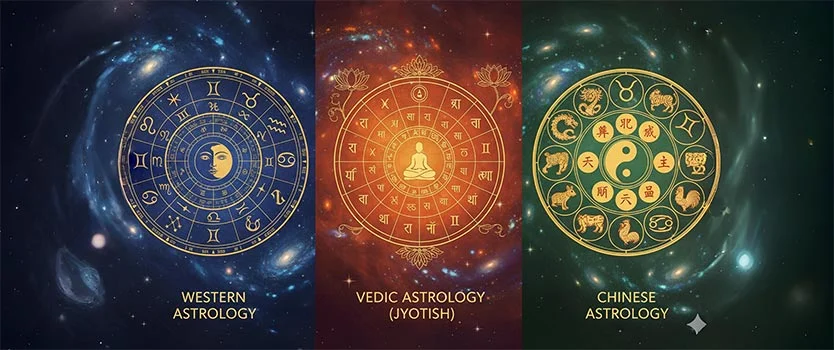
Western Astrology is one of the most widely practiced forms in the modern world. It primarily uses the tropical zodiac, which divides the sky into twelve equal signs based on the Sun’s position. People often rely on it for personality insights, compatibility analysis, and day-to-day predictions.
Western astrology places strong emphasis on the Sun sign, but it also considers the Moon sign, rising sign, and planetary placements to create a detailed birth chart. Because it blends psychology with planetary symbolism, this system feels relatable to many individuals seeking self-awareness.
2. Sidereal Astrology
Sidereal astrology offers a more astronomically aligned approach. Unlike Western astrology, it calculates zodiac positions based on the actual constellations in the sky. This method creates a real-time connection between star clusters and human experiences.
Sidereal calculations are widely used in Indian and some Eastern systems. Many astrologers choose the sidereal zodiac because it matches the real positions of the stars, which helps them create more accurate birth charts.
3. Natal Astrology
Natal astrology, often called birth-chart astrology, focuses on the exact moment a person enters the world. The positions of planets, the Sun, and the Moon at that moment shape one’s personality, strengths, weaknesses, and life path.
This is among the most popular kinds of astrology, as people connect deeply with interpretations that reflect their inner nature. Natal astrology creates individualized guidance rather than general predictions.
4. Electional Astrology
Electional astrology helps individuals choose the perfect time to begin something important. Whether someone plans a marriage, business launch, medical procedure, or travel, astrologers use planetary alignments to identify the most auspicious moment.
The logic is simple: when you start something under favourable cosmic conditions, the chances of success rise significantly. This method is widely used in India and across many ancient cultures
5. Horary Astrology
Horary astrology offers quick and focused answers to specific questions. Instead of analyzing a birth chart, the astrologer studies the chart created at the exact moment the question is asked.
If someone wants to know, “Will I get this job?” or “Is this relationship right for me?”, horary astrology can provide a direct answer. Because the results arrive quickly, this method has grown popular among people seeking immediate clarity.
Also read: Different Types of Astrologers and Their Roles
6. Judicial Astrology
Judicial astrology deals with large-scale events rather than individual lives. Ancient kings relied on it to understand political, environmental, and national outcomes. Astrologers interpret eclipses, planetary conjunctions, and collective energies to foresee societal changes.
Although not as commonly used by individuals today, judicial astrology continues to guide researchers who study world trends through cosmic cycles.
7. Medical Astrology
Medical astrology connects different body parts and health conditions with planets and zodiac signs. Practitioners believe that cosmic energies influence both physical and mental health.
For example, Aries rules the head, Taurus governs the throat, and Virgo represents digestion. By studying planetary movements, medical astrologers identify periods when a person may feel vulnerable or strong, helping them adopt preventive care.
8. Chinese Astrology
Chinese astrology offers a beautifully symbolic system based on twelve animal signs and the five elements: Wood, Fire, Earth, Metal, and Water. Each year carries its own ruling animal and element, shaping collective moods and individual experiences.
Instead of monthly zodiac signs, this system assigns one animal to each year. It provides practical guidance on personality traits, compatibility, fortune cycles, and life purpose.
9. Indian Astrology (Vedic Astrology)
Vedic astrology, also known as Jyotish Shastra, is one of the oldest astrological systems in the world. It relies on sidereal calculations and consists of several specialized branches. This is where the different types of Vedic astrology emerge, such as:
- Jaimini astrology
- Parashari astrology
- Nadi astrology
- KP astrology
Vedic astrology focuses heavily on karma, planetary periods (Dashas), and remedies like mantras, gemstones, and puja rituals. It remains deeply respected for its accuracy and spiritual foundation. Many people rely on it to understand their life purpose, marriage, career, and inner growth.
10. Arab and Persian Astrology
Arab and Persian astrology contributed significantly to the evolution of astrology during the medieval era. Scholars from these regions refined mathematical techniques, planetary interpretations, and timing methods.
Their contributions enriched both Western and Indian astrology. Many calculation methods used today trace back to Arab and Persian manuscripts, making this system historically significant.
11. Celtic Astrology
Celtic astrology takes inspiration from the natural world, especially trees. Instead of zodiac signs, it assigns three symbols to individuals based on their birth dates. Each tree represents a specific personality, emotional pattern, and spiritual lesson.
Because it connects nature and intuition, Celtic astrology appeals to individuals who seek earthy, mystical insights.
12. Egyptian Astrology
Egyptian astrology blends mythology with celestial observation. It has twelve signs, each governed by an Egyptian deity such as Osiris, Isis, Amun, or Horus. Your sign determines your leadership style, emotional nature, and spiritual qualities.
This system celebrates symbolism, transformation, and divine guidance, offering a rich cultural perspective on destiny.
Conclusion
Astrology is not a single system; it is a vast universe of ideas and techniques. When you explore the many kinds of astrology, you begin to understand how different cultures interpret the sky in their own beautiful way. Whether you prefer the scientific precision of sidereal astrology, the depth of Vedic astrology, or the symbolic richness of Egyptian or Celtic systems, each one provides meaningful wisdom.
In a world where people constantly seek clarity and purpose, these types of astrology methods remind us that the cosmos has always been a guiding companion. Astrology continues to evolve, yet its core intention remains the same: helping us navigate life with awareness, direction, and inner balance.
FAQ
Many cultures have developed their own systems of astrology. The most well-known kinds include Western, Vedic, Chinese, Celtic, Egyptian, Horary, Medical, and several others.
Accuracy depends on the purpose and the astrologer’s expertise. Many people find Vedic (Indian) astrology and Sidereal astrology highly precise because they use actual star positions.
Western astrology uses the tropical zodiac based on seasons, while Vedic astrology uses the sidereal zodiac aligned with real constellations.
Yes, many astrologers blend techniques from various systems to gain deeper insight. Combining methods often helps create a more holistic reading.
Vedic astrology, Chinese astrology, and Electional astrology are widely relied upon for predictive guidance. Horary astrology is preferred for answering specific questions.